
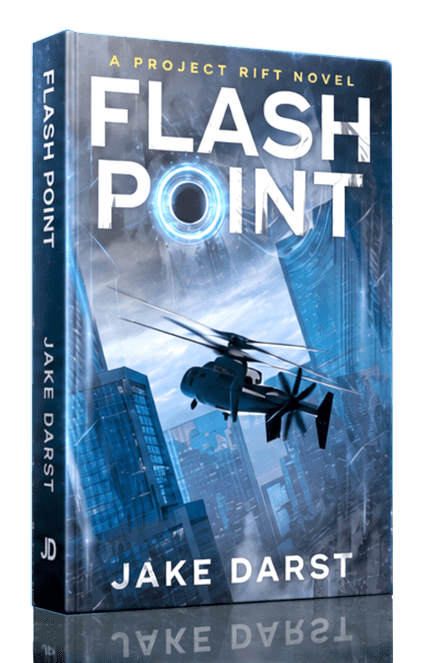
A SECRET EXPERIMENT.
A GLOBAL THREAT.
THE CLOCK IS TICKING.
SAMPLE — FIRST 4 CHAPTERS
Estimated reading time: 18 minutes.
Prefer reading on Kindle or Kobo? Download EPUB here.
🎧 Opening Scene (4 min)
Read by Jeff Gurner
(Daemon • Delta-V • Critical Mass)
EPIGRAPH
Because lethal technologies seem to spring spontaneously from scientific discoveries, most people regard dangerous technology as no more than the bitter fruit of science, the real root of all evil.
— Jacques-Yves Cousteau
CHAPTER ONE
2:00 AM, April 7, 2046
Oak Ridge National Laboratory
Spallation Neutron Source
Through his scope, the Oak Ridge facility looked like a section of illuminated spine curving across the valley floor. Beyond it, a lone red beacon blinked steadily atop a distant water tower.
“Light just went out,” he said softly. “Third floor.” He repositioned his rifle on the log.
“Security inbound, two klicks out.” The soldier to his left, also dressed in black tactical, kept his voice low. “On foot. Estimate ten mikes before we’ll need to relocate.”
A sharp inhale came from behind him. The scientist.
That grated. “Calm down. We’re fine.”
“Not fine,” the soldier countered. “You rushed into this. You do not execute this kind of an op without full recon and a clean exfil plan.”
“Guys,” the scientist blurted, “none of that matters if Maddox runs this test and—”
His elbow caught the scientist in the ribs. “I know the stakes.”
He hated that the soldier was right. Hated his controlled, methodical manner. The reminder of what he, himself, had once been—before. But time was one thing he no longer possessed.
Unbidden, the memories rose. His hand clenched, forcing them aside. Now was not the place; he needed to be at one hundred percent to complete this mission.
He looked across the ridge at a glow rising from behind distant trees and knew what to do. “We’ll hit the power junction. Force evacuation, finish it fast.”
“No.” The soldier’s tone was flat, hard. “The area’s too visible, and cameras are everywhere. Response would be immediate. You’d have no exfil.” He glared across the darkness. “I told you. You don’t soft-crash a federal research site and walk away invisible.”
“All right, hotshot. What would you do?”
The soldier coughed a single, bitter laugh. “What I’ve advocated since you first recruited me. ISR, internal maps, overwatch. We have none of that.”
“We’ll adapt.”
“This isn’t adapting. This is winging it. That how they operate where you come from? Cause it sure as hell isn’t how we work here.”
He lost the soldier’s last words, the phrase, ‘where you come from’ throwing him forcibly out of the present. Shadows, bending the wrong way—
A hand landed on his shoulder, and he realized the scientist had been calling his name. Concerned eyes peered into his. “Stay with me.”
He shrugged the hand off. “No names,” he snapped quietly. “Use the callsigns.”
The scientist shot him a glare. “Okay, Six. Are you all right? Maybe Two should take over—”
“I’m fine. Focus.” He swung his scope back to the building. “If we can’t get inside tonight, we pivot.”
“Pivot to what?” the soldier asked.
“Maddox.”
The scientist stared at him, shocked. “That’s… not what we discussed.”
The soldier rolled to his feet. “Then stop changing the damn plan and let me work.”
CHAPTER TWO
Grayson Maddox and his assistant were the only two people in the Oak Ridge building this late. It was how he preferred to work. His research—funded by DARPA, the Defense Advanced Research Projects Agency—was classified, close-held. And he was about to prove the improbable.
Aside from the soft rustle of clothing, the only sound in the SNS control room was the rhythmic ticking of the accumulator ring, subliminal warning that it was live. Part linear accelerator, part particle racetrack, the Spallation Neutron Source served a single purpose tonight—and answered to a single man.
“You adjusted the magnetic fields the way we discussed?”
Mari, his research assistant, waved him over. “All checkpoints show green.”
Grayson looked at the sensor readings. She was right. Everything was in order. “Do it.”
Mari input the command. The ticking sped up, a ting-ting-ting that rose in pitch. Half of the screens flipped to remote visuals—flashing lights racing down a long tunnel. That stretch was radioactive when live. Deadly. Off-limits to humans.
A tone sounded. “Proton stream released,” Mari said. “Approaching point nine c… Redirecting the stream to the tunnel—now.”
In the blink of an eye, the test was over, finished the moment it had begun. In a millionth of a second, hundreds of trillions of protons had flung themselves against a mercury barrier. That impact released neutrons. What these neutrons did next was why Grayson was here.
He waited impatiently while the quantum supercomputer churned through sensor data. It was a vast amount of information, but the SNS had a titan of a machine working on it. The results didn’t take long; it just felt like it.
When the icon flashed ready, he skimmed the results, then blinked, hardly daring to believe what he read.
Mari’s breath hitched. “It worked,” she whispered.
She leapt from her chair and threw her arms around his neck. “We did it!”
“We did.” Grayson hugged her back, catching the faint floral scent of her shampoo. “You know what this means.”
“Repeat the test, get the same results. I know. I—”
Her words cut off with a gasp as the control room plunged into total blackness. Grayson reacted instantly to the change. He released Mari but kept one hand on her shoulder as his senses snapped to high alert. In the distance, a warning klaxon sounded.
Mari tensed beneath his grip. “Shouldn’t we have emergency lights by now?”
“Yes.” He steered her toward the exit, mentally counting the seconds. At seven seconds, emergency lights kicked on.
Mari spun back toward the console. “I need to make sure we didn’t lose the superconducting magnets—”
“No, we need to get up to the office. Copy all the data from this last run over to a secure drive and store it in the fire safe.” Grayson pulled her out into the hall. “We can’t afford to lose what we just discovered.”
He hustled her past the elevators to the stairwell. Their offices were on the third floor; he took the steps two at a time, leaving Mari to catch up.
Grayson knew that this wasn’t a standard power outage. Oak Ridge’s grid was AI-controlled, with redundancies that rivaled a large city. Emergency lights should never have come on. Power should have flickered, then steadied. This was more than just an outage.
He stopped at the entrance to Mari’s office. With the electronic locks offline, he’d need to do a little tampering to gain access. He pulled a card from his wallet and got to work. Mari reached him just as he swung open the jimmied door.
“How’d you—? Never mind. I don’t think I want to know.”
“Grab everything you can and put it in the fire safe,” Grayson said. “Wait here until I get back. Don’t open the door for anyone but me.”
“But…” Mari sounded dismayed, unsure of herself. “It’s just a power outage.”
“Backup generators should have kicked in seamlessly. Something’s wrong.”
Mari reached out as if to stop him. “Gray, this is a classified government facility. You’re not deployed any longer.” Her voice gentled. “No one’s waiting to ambush you.”
Grayson knew that tone. She thought this was PTSD. Hypervigilance. She was wrong. He gave her a hard look. “Stay here. I’ll be back soon.”
He pulled the door closed behind him, then took off toward his own office and his own fire safe. Only his held more than just data files. He didn’t bother to unlock the door this time, just rammed his boot against the doorknob. The metal jam gave way.
The weapons locker posing as a fire safe sat tucked away under a desk. Its biometric scanner accepted his palmprint and opened. Beneath a mound of data chits was a case that held his service pistol. He pulled it out, along with several spare magazines. Two, he pocketed. The third, he slammed home with a metallic click. He gave it a sharp tug, then press-checked the slide.
He paused outside his office, listened, heard nothing. If there was a threat, it was outside the building. What he’d told Mari was the truth: a power outage was unlikely in a facility like this. In all the years he’d worked with linear accelerators, he’d never seen a complete failure like the one that had just occurred. Factor in the convenient timing, and it was enough to make him go on the offensive.
He headed down the stairwell, using his visual implant’s blink interface to call security.
One of the first things he’d done when he’d arrived at Oak Ridge was to recon the campus, a habit he’d picked up while deployed. He knew everyone who worked at the facility. The voice that answered was not one he recognized.
“Security,” the stranger said.
Grayson adopted a tone of annoyance and casual concern. “Hey, this is Maddox over at the SNS. The power’s out. Any idea when we’ll get it back?”
“Sorry, sir. Maintenance is checking it out now. I show that you have backups online.”
“We do,” he confirmed, slipping out the main exit and into the unlit night. “But we need to be on the grid to run the SNS. Got an ETA?”
“I’ll let you know when I hear one.” The voice sounded less guarded now.
“Thanks.”
Maybe the guy was just a recent hire, nervous about his new job. Or…
Grayson decided to follow up with maintenance. Confirm for himself that they were working on the problem. The campus directory was loaded in his wristband. He pulled up the number and placed the call.
The man who answered sounded harried. He hadn’t heard about the outage; he’d been busy putting out a bigger fire—a campus-wide cyberattack. The engineer assured him that they’d send someone over immediately to check.
Grayson disconnected, then faded into the shadows, following the curve of the building toward the main power junction. A cyberattack was a reasonable explanation. Still, Grayson needed to be sure.
His biggest concern was the red-tagged gas generator he’d noticed during his introductory tour. Decommissioned but not removed when Oak Ridge converted to clean energy in the 2040s, it was useless to anyone except in dire emergencies—or to someone who wanted to remain completely off radar. Someone bent on sabotage.
Sounds from up ahead told him that he wasn’t alone. He slowed, grateful for the dark hoodie that concealed his light-colored shirt. He pulled the hood forward to hide his face, then eased closer.
A security guard stood with one hand resting lightly on his holstered weapon, his gaze sweeping the darkness. Grayson recognized him. He seemed tense, but Grayson was self-aware enough to realize that he could be projecting his own concerns onto the younger man. And it wasn’t fair to measure a civilian’s readiness against soldiers like those in Grayson’s former unit.
Reminding himself of Mari’s words, he tucked his pistol inside his hoodie pocket and stepped out from the shadows. The guard’s reaction was instant and a bit jumpy. Grayson held up a hand.
“Relax, Sam, it’s just me. I was inside, working late. Came out to see what was going on.”
The young guard smiled tightly. “Nothing to worry about here, sir. Maintenance is looking into it and should have everything restored soon.”
It sounded to Grayson like Sam was trying to get rid of him.
“I heard about the cyberattack. You worried it’s more than that?”
Sam looked relieved. “Oh, so you know about it.”
“Yeah. I called.”
Sam shrugged as if to loosen the strain in his neck. “First excitement we’ve had since I was hired,” he confessed.
Now Sam’s tension made sense. Grayson relaxed, recalling the electric thrill he’d had during his first mission. Those jitters were the same everywhere, it seemed.
“Glad to hear you’re on top of it.” He tossed Sam a wave and turned to go. “Keep up the good work.”
• • •
The intruder stepped out of the shadows behind Sam, nudging the security guard in the kidney to remind him of the gun that had been trained on him the entire time.
“Good job, kid.” He spoke in the security guard’s ear, too low for the retreating Maddox to hear. “Just stay cool, now. Don’t blow it. We’re almost done.”
They stood watching as the hoodie-wearing scientist disappeared around the corner.
Grayson Maddox had been armed; the scientist’s hand had never left his pocket. While Maddox’s casual pose might have fooled Sam the security guard, the intruder had clocked a watchful alertness in his eyes.
It was good that things hadn’t turned messy. More efficient that way.
“Okay, remove your weapon, nice and slow, and drop it to the ground. Good… good. Kick it back toward me.” The camo-clad intruder scooped up the gun and holstered it. “Now, we’re going to—”
His words cut off at the sound of voices coming from behind and feet tramping down the graveled accessway.
“Who the hell is that?” he whispered fiercely.
Sam’s voice wavered. “It sounds like maintenance.”
“I told you not to call them!”
“I didn’t!” Sam protested. “Doctor Maddox must have!” With a silent curse, the intruder backed swiftly away. Tonight’s op was blown. It was time to get the hell away from Oak Ridge.
CHAPTER THREE
The unanswered questions surrounding the outage at Oak Ridge faded over the following weeks beneath a relentless cycle of test runs. Each iteration confirmed the discovery: reproducible signatures, scalable results, no artifacts or errors. When his DARPA superiors learned that he’d shifted to molecular transfers, they summoned him to the Johns Hopkins Applied Physics Laboratory in Laurel, Maryland.
Which was why he was now crawling along a gridlocked stretch of I-95 through Baltimore in the predawn rain, wipers thumping, brake lights smearing red halos through the downpour.
“I don’t have time for this,” Grayson muttered.
He made a quick decision. If he wanted to reach APL on time, he’d have to bypass the rental’s AI. Using his government ID, he hacked the controls, ignored the warning about voiding the agreement, and took the wheel. A few deft moves later, he’d traded the traffic jam for side streets. The safety lockout made sense—less wear, fewer accidents. But he wasn’t a tourist. He’d lived here once.
The car’s headlights sliced through the driving rain, illuminating the gray forms of houses that lined the road ahead. Lights flickered on as the sleepy suburb awoke. He glanced at his wristband, noting the time. He had a half-hour drive ahead of him and a research assistant back home who should be awake by now. If he couldn’t review his notes, at least he could practice his speech on her.
“Sascha,” he said, activating his wristband’s AI. “Call Mari.”
A pleasant female voice projected into his ear. “Connecting.” In his lower left field of view, a handset icon appeared on his optical implant, concentric arcs radiating outward.
“Hey,” a sleepy voice sounded on the other end. “Everything okay?”
“Other than a Maryland downpour? Sure. You busy?”
“Gray, do you know what time it is?”
“I thought I’d run my speech past you while I drove.”
Mari groaned. “You bypassed the AI again, didn’t you?”
“Mari…”
“Fine, hang on,” she sighed. He heard the gurgle of coffee being dispensed. “No promises, though, until I get some caffeine in me.”
“Understood. Ready?”
“Hit me.”
“Okay, I begin with a brief history of Oak Ridge’s research from the early 2000s—”
“Are you sure you need to go there?” Mari asked. “Why not cut to the chase? Just tell them what we’ve done. We scaled it! Oscillated entire molecular structures to a mirror universe and back again. The implications of this are… are…”
He smiled at her enthusiasm. “Astounding? Unbelievable? Epic?”
“Now you’re making fun of me.”
“Never. But I can tell the caffeine’s kicking in.”
Mari blew him a raspberry. “Hey, I have as much skin in the game as you do.”
“I know.” She’d been with him from the start, assigned to him by Oak Ridge. “It’d be nice to grab them with the news right away, but the folks at DARPA don’t know the science like we do. A little history to bring them up to speed won’t hurt.”
“I thought they were the ones behind the research.”
Grayson was careful with his response. Mari knew the Defense Advanced Research Projects Agency funded them, but that was all she knew. “Not everyone at DARPA is a particle physicist, you know,” he said. “I’ll keep it brief. Most of them probably don’t even know what RIFT stands for.”
“Gray, half the time you can’t even remember.”
“See? And I named the damn thing.”
There was a pause on the other end, then Mari’s voice returned. “Can I call you back in a few? My neighbor dropped by to pick up her cat.”
“The one with the weird name? Mcflufferpants or something?”
“No, he belongs to the kids next door. This is the symphony conductor with the Siamese named Yo-Yo Meow. Oops, doorbell’s ringing again Gotta go.” The call ended.
“Yo-Yo— Whatever happened to Tiger or Spot?”
Names mattered. He’d spent weeks reverse-engineering an acronym that would sell DARPA on Resonance-Induced Frame Transport.
The government loved its acronyms. So had the Unit.
Damn, but that’s been a minute.
CHAPTER FOUR
Access road, Laurel, Maryland
The feed wasn’t optimal, thanks to the thick cloud deck covering the D.C.–Baltimore–Annapolis triangle. Fortunately, Six’s Kilo team had insider access to their target’s itinerary: Kilo Three had hacked the rental car’s database. That data now floated above Three’s wristband, lying flat on a stack of boxes in the back of the van.
Earlier, they’d swathed the van’s interior with material that defeated IR heat mapping and prevented eyes—both human and electronic—from seeing inside. The last thing they needed was to be caught in a routine security sweep. It wouldn’t be easy to explain away three people hanging out in a space ordinarily used for shipments, particularly in this part of the country.
Three manipulated the hologram he’d called up. He spread his fingers wide to enlarge the view, then poked a finger at the red dot in the center. “That’s him.”
“Too bad we don’t have a drone out there,” Four said. Even now, the scientist sounded uncomfortable. “It’d be nice to have confirmation before we do this.”
Three shot Six a covert look, wondering how their leader would handle that remark.
When Six didn’t respond to Four’s comment, Three murmured, “Visibility’s for shit out there.”
“Drones could compensate.”
“They could, but we’re in a hot zone,” Three explained. “You do not fly an unauthorized drone of any size in the D.C. corridor. Too much security in the area.”
Six ignored the exchange, cold gray eyes intent upon the display. “Any news from Two?”
The soldier had been sent back to Oak Ridge to finish the mission they’d failed to complete a few weeks ago. He was unaware of this op, and Six had good reason to keep it that way.
“No. I’ll ping him.” Three sat back, gazing up at the ribbed metal underside of the van’s roof, wirelessly linking his brain-machine interface to the wristband’s quantum chip.
The device lying on the box looked exactly like a commercial wristband, the kind the average person would wear. Using an untraceable alias, Kilo Four had purchased blocks of prepaid wireless time for use on whatever network was in range.
The difference was in its quantum chip. Not even DARPA was aware of its existence. More importantly, the encryption algorithm buried deep inside its bendable glass frame was exclusive to their team. No nation on the planet could breach its security.
A few seconds passed as Three sent a quick message to their missing teammate. A minute later, Three’s eyes refocused on Six. “Two’s on site,” he informed his leader. “Infiltration in progress.”
“Good.”
The dot jostled, drawing Three’s attention. Their target was approaching his destination.
Six saw it too. “Check the charges,” he ordered. “We have one shot at this. Don’t blow it.”
“Interesting word choice,” muttered Four. “Since that’s exactly what you’re planning to do.”
YOU’VE REACHED THE END
OF THIS PREVIEW
THE TRAP IS SET.
Maddox has no idea who betrayed him.
By the time he finds out,
it may already be too late.
• • •
ACCESS LEVEL: CLEARED
Receive launch intel, bonus scenes,
and Project RIFT updates.